March 23, 2026 (Zoom)
Trout Fryxell RT, KV Smith, and JC Chandler. Minutes of the National Exotic and Invasive Vector Species Stakeholder Call. 20 July 2026. Knoxville, TN/Online.
Meeting notes were initially reported with Zoom AI and edited by the team at the University of Tennessee.
101 participants of 387 invited (26%)
Quick recap
The meeting focused on updates regarding Haemaphysalis longicornis and Amblyomma maculatum surveillance and reporting across various states. Participants discussed launching a new website that hosts interactive maps for tracking tick populations and reporting new findings. The group reviewed recent detection updates, including new reports from New Jersey, New York, and Ohio, and discussed the challenges of standardizing PCR testing for tick-borne diseases (e.g., Theileria). USDA-ADPHIS provided insights into the resurgence of New World Screwworm (NWS), explaining factors such as illegal animal movement and environmental changes contributing to its spread. The meeting emphasized the importance of voluntary reporting to improve data accuracy and support research efforts. Participants were encouraged to submit updates and data through the new portal to enhance the maps’ utility for stakeholders, including academics and state agencies.
Requests
- All participants should submit any new or historical tick and/or Theileria data (including county/state information and, if possible, details on the assay/PCR method used) via the new website form or by email/Excel to the organizing team at the University of Tennessee. New reports should also be sent to NVSL.
- Send manuscripts and relevant publications to the organizing team for posting on the project website.
- Sign up for APHIS Stakeholder registries to receive immediate updates on New World Screwworm status.
Summary
Pest Species Website Launch Updates
The meeting focused on updates regarding exotic and invasive pest species, particularly ticks, and the launch of a new website featuring live maps. Participants discussed data collection efforts. The group planned to review the website’s functionality, including a new “notify us” feature. The website address is: www.VectorVBDWatch.tennessee.edu
Asian Longhorned Tick Surveillance Updates
The meeting focused on updates regarding Haemaphysalis longicornis and Amblyomma maculatum surveillance across different states. Participants reported no new updates from Maine, Massachusetts, Missouri, New Hampshire, New Jersey, North Carolina, Ohio, Pennsylvania, Rhode Island, South Carolina, Tennessee, Virginia, West Virginia, and Washington D.C. However, updates were shared from New York and Ohio. New York confirmed a new record for Albany County (mentioned in the previous month’s call), where a tick was found in July 2025 and confirmed in February 2026. Ohio reported a suspect nymph in Tuscarawas County on March 8th.
Theileria Mapping System Discussion
The team discussed a new mapping system for tracking Theileria and H. longicornis occurrences across counties. The University of Tennessee demonstrated how to use the interactive maps, including features like zooming and viewing legends. The group clarified that Theileria is a voluntary but notifiable pathogen, meaning reports are encouraged but not mandatory, and information submitted will be shared with NVSL. Concerns about protecting producer privacy when submitting reports, and the team confirmed that while the system is behind on updates, they will verify information with NVSL and encourage dual reporting to both the new system and NVSL. The team agreed to accept reports of older Theileria infections from state labs and to track which specific assays different labs are using.
Gulf Coast Ticks Discovery and Distribution
The group discussed a recent finding of reports of Gulf Coast ticks in Delaware from 1946, which contradicts previous genetic and historical analysis suggesting they were distributed more north before cutting back to the historical range along the Gulf. The 1946 report by Biquark, mentioned the ticks’ distribution from Florida to Virginia and their presence in the Mid-Atlantic region in the early 1900s. The team debated whether to use terms like “re-emerging” or “native invasive” for these ticks. The group discussed whether tick range expansion (A. maculatum) should be considered invasive; it was concluded that native ticks undergoing range expansion are neither exotic nor invasive and we should use the term used by USDA and CDC.
Screwworm Surveillance and Control Efforts
The discussion focused on New World Screwworm surveillance and control efforts. Sterile flies are being distributed in Tamaulipas, Mexico and South Texas, with traps set up along the border to monitor for wild flies. While sterile flies have been detected in traps, no wild flies have been found at the time of reporting. The team is also developing a new truck-based dispersal method and has secured a contract for a production facility at Moore Air Base in Texas, which is expected to produce 100 million flies weekly by 2027, with the capacity to increase to 300 million flies per week later.
The difference between dispersal and production facilities was explained, noting that dispersal facilities handle pupae and allow pupae to emerge before release, while production facilities deal with adult flies. It was mentioned that CDC handles human myiasis cases and USDA handles animal cases, with information available on the screwworm.gov website. The group discussed resources for tracking NWS presence, including a website that lets users check whether the pest is currently present in specific areas, as well as suggestions for signing up for APHIS Stakeholder registries to receive timely updates.
The resurgence of New World Screwworm in recent years is attributed to several factors, including lack of knowledge among new generations of producers, illegal animal movement, environmental changes, and the overlap between wild and farm areas in the Darien Gap region. More reasons may be possible as well, but definitive reasons are unknown.
Notes from the chat
Links to manuscripts
- Simberloff, Daniel, et al. “The natives are restless, but not often and mostly when disturbed.” Ecology 93.3 (2012): 598-607. https://doi.org/10.1890/11-1232.1
- MacCreary D. 1945. Ticks of Delaware with special reference to Dermacentor variabilis (Say) vector of Rocky Mountain spotted fever. Bull. Del. Univ. Agric. Exp. Sta. 252:5–22. https://pmc.ncbi.nlm.nih.gov/articles/PMC12271736/#CIT0090
- Iannone, B. V., Carnevale, S., Main, M. B., Hill, J. E., McConnell, J. B., Johnson, S. A., Enloe, S. F., Andreu, M., Bell, E. C., Cuda, J. P., & Baker, S. M. (2020). Invasive Species Terminology: Standardizing for Stakeholder Education. Journal of Extension, 58(3), Article 27. https://doi.org/10.34068/joe.58.03.27
Haemaphysalis longicornis distribution as of March 2026 based on NVSL report
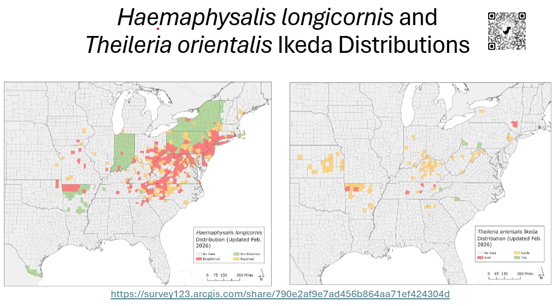
| State/Jurisdiction | Potential Counties | Number of Counties with Detections | Percent Infested |
|---|---|---|---|
| Washington, DC | 1 | 1 | 100% |
| New Jersey | 21 | 21 | 100% |
| Delaware | 3 | 3 | 100% |
| West Virginia | 55 | 37 | 67% |
| Rhode Island | 5 | 3 | 60% |
| Connecticut | 8 | 4 | 50% |
| Pennsylvania | 67 | 34 | 51% |
| Maryland | 24 | 11 | 46% |
| Virginia | 134 | 50 | 37% |
| North Carolina | 100 | 36 | 36% |
| Massachusetts | 14 | 4 | 29% |
| New York | 62 | 19 | 31% |
| Ohio | 88 | 27 | 31% |
| Kentucky | 120 | 17 | 14% |
| Tennessee | 95 | 13 | 14% |
| South Carolina | 46 | 4 | 9% |
| Arkansas | 75 | 8 | 11% |
| Indiana | 92 | 6 | 7% |
| Missouri | 115 | 7 | 6% |
| Maine | 16 | 1 | 6% |
| Illinois | 102 | 3 | 3% |
| Oklahoma | 77 | 2 | 3% |
| Georgia | 159 | 4 | 3% |
| Iowa | 99 | 3 | 3% |
| Michigan | 83 | 1 | 1% |
| Kansas | 105 | 1 | 1% |
| New Hampshire | 10 | 1 | 10% |
Haemaphysalis longicornis Positive Host Information
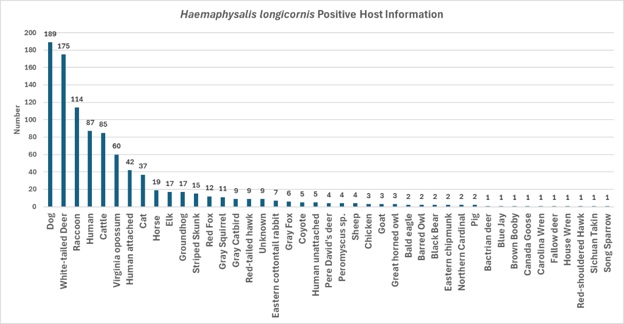
| Host Animal | Number of Cases |
|---|---|
| Dog | 189 |
| White-tailed Deer | 175 |
| Raccoon | 114 |
| Human | 87 |
| Cattle | 85 |
| Virginia Opossum | 60 |
| Human attached | 42 |
| Cat | 37 |
| Horse | 19 |
| Elk | 17 |
| Groundhog | 17 |
| Striped Skunk | 15 |
| Red Fox | 12 |
| Gray Squirrel | 11 |
| Gray Catbird | 9 |
| Red-tailed Hawk | 9 |
| Unknown | 9 |
| Eastern Cottontail Rabbit | 7 |
| Gray Fox | 6 |
| Coyote | 5 |
| Human unattached | 5 |
| Pere David’s Deer | 4 |
| Peromyscus sp. | 4 |
| Sheep | 4 |
| Chicken | 3 |
| Goat | 3 |
| Great Horned Owl | 3 |
| Bald Eagle | 2 |
| Barred Owl | 2 |
| Black Bear | 2 |
| Eastern Chipmunk | 2 |
| Northern Cardinal | 2 |
| Pig | 2 |
| Bactrian Deer | 1 |
| Blue Jay | 1 |
| Brown Bobby | 1 |
| Canada Goose | 1 |
| Carolina Wren | 1 |
| Fallow Deer | 1 |
| House Wren | 1 |
| Red-shouldered Hawk | 1 |
| Sichuan Takin | 1 |
| Song Sparrow | 1 |