April 20, 2026 (Zoom)
Trout Fryxell RT, KV Smith, and JC Chandler. Minutes of the National Exotic and Invasive Vector Species Stakeholder Call. 20 April 2026. Knoxville, TN/Online.
Meeting notes were initially reported with Zoom AI and edited by the team at the University of Tennessee.
122 participants of 389 invited (31.4%)
Quick recap
This meeting focused on updates regarding New World Screwworm (NWS) surveillance and response planning. Denise Bonilla from USDA APHIS presented the updated New World Screwworm Response Playbook, explaining the three pillars of eradication and current sterile insect technique operations in the United States. The group discussed the status of NWS in Mexico, with cases now detected within 90 miles of the U.S. border. Surveillance plans were reviewed across different states for both NWS and the related tick-borne pathogen, Theileria orientalis Ikeda, which is transmitted by Haemaphysalis longicornis. Participants shared recent detection updates, including new county-level findings in Georgia and reports from various states on Theileria surveillance in ticks and cattle. The meeting also covered practical aspects of response planning, including movement controls, animal treatment protocols, and the importance of proper navel treatment with iodine for newborn animals to prevent Screwworm infestations (females oviposit in wounds).
Notes and Collaboration/Requests
- The May meeting was canceled so groups can catch up on records, data entry, documentation, and more. Requests were made for all participants to submit new tick and Theileria records through the UT VectorWatch survey.
- All participants are recommended to register for USDA APHIS Stakeholder Registry for first-line information updates about NWS status. Please review and use the updated New World Screwworm Response Playbook (released April 8th) for operational planning. Review FDA emergency use authorizations for new pesticides and treatment options (more coming in next month) on screwworm.gov
- A consensus was agreed to implement enhanced tick control measures as part of screwworm preparedness.
Summary
The meeting focused on updates regarding New World Screwworm and related tick surveillance. No new detections or reports of New World Screwworm have been received.
Haemaphysalis longicornis Distribution Updates
The meeting focused on updates regarding H. longicornis distribution and detection across various states. Updates were shared from Delaware, Georgia, and Illinois, with significant findings including the first nymphs and larvae detected in Delaware on specific dates, and new tick discoveries in Floyd County, Georgia. A report for a tick in Maine was confirmed, but the report mentioned a need to follow up on specific details including county information, date collected, and agencies involved. In New Jersey, a significant number of nymphs were reported, with the first collections detected in March. Vermont shared that cattle tested positive for Theileria in February, though the animals were not clinically ill, and the finding was incidental.
The group also discussed challenges around collecting and reporting cattle tick samples due to potential economic impacts and state quarantine policies. Some emphasized that producers may be reluctant to participate due to concerns about restrictions on animal movement and economic penalties. The group discussed challenges with collecting data on pathogen-positive animals and engaging producers, noting that county-level information may be acceptable to producers despite privacy concerns. Discussion about updating the survey to remove the requirements for city and zip code information occurred and use of NA was suggested.
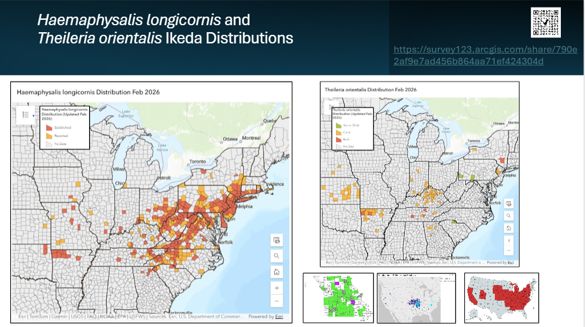
The group discussed updated maps showing the distribution of established and reported counties for ticks like H. longicornis and Theileria orientalis Ikeda. Dr Lahmers, at Virginia, mentioned a county-level map of Theileria-positive cattle, which will be integrated with the existing surveillance data. Additional maps were identified by the University of Tennessee Team.
Links about Asian longhorned tick and Theileria
- Survey for updating detection
- Link to website with the map
- Bovine Theileria orientalis Ikeda Updated Map by Kansas State
- Confirmed cases of Asian longhorned tick and Theileria orientalis by Missouri Dept of Agriculture
Screwworm Prevention, Response, and Surveillance Updates
Bonilla from USDA-APHIS presented an updated New World Screwworm response, explaining the three pillars of eradication, including sterile insect technique, and emphasized the need for movement controls and early detection if an incursion were to occur. The team discussed the 2026 New World Screwworm Response Playbook (linked below). While there are no wild screwworms currently present in the US, sterile flies are being dispersed across Mexico and the southern US to prevent infestations. The team is monitoring potential cases through traps and surveillance systems, with recent positive cases found near the US-Mexico border.
The response playbook includes eight key activities such as managing a unified response, protecting unaffected areas, and deploying traps and sterile flies. Producer education and outreach were emphasized to change practices that could increase the risk of screwworm, particularly in animal handling and birthing procedures. The team continues to work with international partners in Mexico and maintains surveillance through various methods.
The meeting focused on Screwworm prevention and control measures. Audits are conducted in Mexico to identify effective intervention strategies, with multiple visits across different regions. The group discussed proper navel treatment procedures, recommending 7% tincture of iodine and the use of insecticides for prevention and treatment, especially in infested areas. The conversation ended with highlighting the connection between tick control and Screwworm prevention, noting that tick bites serve as entry points for Screwworm infestations.
Links about New World Screwworm
- New World Screwworm Playbook v2, USDA APHIS April 2026.
- Stop Screwworm: Unified government response to protect the United States
- Stop Screwworm: Current status
- Approval and Conditional Approval of Animal Drugs for NWS
Haemaphysalis longicornis distribution as of April 2026 based on NVSL report
| State/Jurisdiction | Potential Counties | Number of Counties with Detections | Percent Infected |
|---|---|---|---|
| Washington DC | 1 | 1 | 100% |
| New Jersey | 21 | 21 | 100% |
| Delaware | 3 | 3 | 100% |
| West Virginia | 55 | 37 | 67% |
| Rhode Island | 5 | 3 | 60% |
| Connecticut | 8 | 4 | 50% |
| Pennsylvania | 67 | 34 | 51% |
| Maryland | 24 | 11 | 46% |
| Virginia | 134 | 50 | 37% |
| North Carolina | 100 | 36 | 36% |
| Massachusetts | 14 | 4 | 29% |
| New York | 62 | 19 | 31% |
| Ohio | 88 | 27 | 31% |
| Kentucky | 120 | 17 | 14% |
| Tennessee | 95 | 13 | 14% |
| South Carolina | 46 | 4 | 9% |
| Arkansas | 75 | 8 | 11% |
| Indiana | 92 | 6 | 7% |
| Missouri | 115 | 7 | 6% |
| Maine | 16 | 1 | 6% |
| Illinois | 102 | 3 | 3% |
| Oklahoma | 77 | 2 | 3% |
| Georgia | 159 | 4 | 3% |
| Iowa | 99 | 3 | 3% |
| Michigan | 83 | 1 | 1% |
| Kansas | 105 | 1 | 1% |
| New Hampshire | 10 | 1 | 10% |
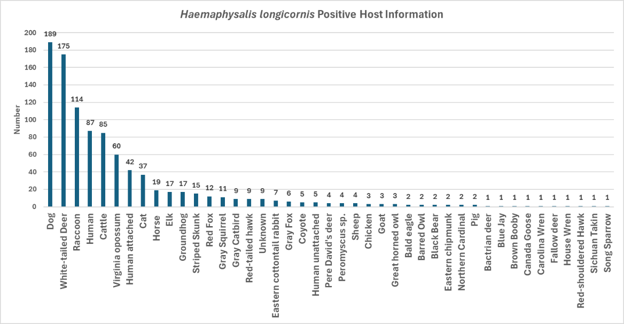
Haemaphysalis longicornis Positive Host Information
| Host | Number of Cases |
|---|---|
| Dog | 189 |
| White-tailed Deer | 175 |
| Raccoon | 114 |
| Human | 87 |
| Cattle | 85 |
| Virginia opossum | 60 |
| Human attached | 42 |
| Cat | 37 |
| Horse | 19 |
| Elk | 17 |
| Groundhog | 17 |
| Striped Skunk | 15 |
| Red Fox | 12 |
| Gray Squirrel | 11 |
| Gray Catbird | 9 |
| Red-tailed Hawk | 9 |
| Unknown | 9 |
| Eastern Cottontail Rabbit | 7 |
| Gray Fox | 6 |
| Coyote | 5 |
| Human Unattached | 5 |
| Pere David’s Deer | 4 |
| Peromyscus sp. | 4 |
| Sheep | 4 |
| Chicken | 3 |
| Goat | 3 |
| Great Horned Owl | 3 |
| Bald Eagle | 2 |
| Barred Owl | 2 |
| Black Bear | 2 |
| Eastern Chipmunk | 2 |
| Northern Cardinal | 2 |
| Pig | 2 |
| Bactrian Deer | 1 |
| Blue Jay | 1 |
| Brown Bobby | 1 |
| Canada Goose | 1 |
| Carolina Wren | 1 |
| Fallow Deer | 1 |
| House Wren | 1 |
| Red-shouldered Hawk | 1 |
| Sichuan Takin | 1 |
| Song Sparrow | 1 |