July 20, 2026 (Zoom)
Trout Fryxell RT, KV Smith, and JC Chandler. Minutes of the National Exotic and Invasive Vector Species Stakeholder Call. 20 July 2026. Knoxville, TN/Online.
Meeting notes were initially reported with Zoom AI and edited by the team at the University of Tennessee.
105 participants/400 invited (26.3%)
Next Meeting 24August2026.
Quick recap
The meeting focused on updates and discussions about exotic and invasive pest species, particularly New World screwworm (NWS) and Asian longhorned ticks (ALTs). Trout Fryxell led the session, providing an overview of current cases and distribution maps, highlighting active and inactive NWS cases in Texas and the spread of ALT ticks across 27 states. Participants from various states shared updates on surveillance, detection, and management efforts, noting increases in tick populations and cases of Theileria in several regions. Challenges with T. orientalis Ikeda diagnostic testing and genotype identification were discussed, as well as the variety of management strategies being used by producers. Overall, the meeting served as a platform for stakeholders to exchange information on the ongoing efforts to monitor and control these invasive pests.
Agenda
- New World Screwworm (NWS) update as of July 18, 2026. There is one active state (Texas) and information can be found at https://www.aphis.usda.gov/animals/animal-health/livestock-and-poultry-disease/current-status/us-confirmed-cases-new-world
- Asian longhorned tick (ALT) update as of July 18, 2026. There are 27 active states (AL, AR, CT, DE, GA, IL, IN, IA, KS, KY, ME, MD, MA, MI, MO, NH, NJ, NY, NC, OH, OK, PA, RI, SC, TN, VA, WV) and county level information can be viewed at vectorvbdwatch.tennessee.edu/longhorned_tick_and_theileria/.
- Roll Call combined with NWS and ALTS.
Next steps
- TroutFryxell- Connect Patty (Vermont) with the contact at the Connecticut Ag Experiment Station for information on tick activity.
- Boyer– Provide the list of 7 counties in Pennsylvania with new Asian longhorned tick establishment.
- Caramack- Follow up on the reported positive counties in Oklahoma to verify the information.
- Pesapane- Follow up on a possible new county and potential new counties with Theileria in Ohio.
Asian Longhorned tick and Theileria Updates.
Trout Fryxell led a discussion on the status of longhorn ticks across various states, with participants reporting updates from their respective regions. Kelly/Arkansas reported finding ticks and Theileria-positive cattle on a farm in Van Buren County, noting that they often discover sick animals before finding the ticks that caused the infection. Frustration was expressed that some diagnostic labs cannot differentiate (choose not to) between different genotypes of the pathogen. Olds/Kansas shared that an Arkansas herd had disease with only Chitose genotype and no Ikeda, suggesting that Chitose can also be pathogenic in the right context. Kennedy reported from Delaware that longhorned tick numbers have tripled year-over-year and have become the second most common tick species after lone star ticks, overtaking blacklegged and dog ticks. Carrasquilla Ferro from Kentucky mentioned a new report from Jefferson County involving ticks collected from a deer, while Tiffin noted no new Extension reports of the tick. Gary Fish from Maine discussed ongoing issues with Powassan virus, including a human death, while Michigan and Missouri reported no new updates. Kobbekaduwa from North Carolina reported no new updates on tick surveillance, with ongoing active surveillance in counties without previous tick information. Pesapane from Ohio shared that Theileria numbers have increased this year with over 4 times as many detections compared to 2021, though field surveillance at affected sites has shown promising results with producer-managed control measures. She explained that different producers are using various approaches including spraying, ear tags, mowing, and pesticide treatments, with some showing improvement in tick numbers. Boyer reported that Pennsylvania now has seven counties with confirmed cases, with numbers exceeding last year’s figures. Scharko from South Carolina mentioned clinical blue tongue cases in cattle, which was new information. Smith shared findings from Tennessee, where a heavily infested farm in Claiborne County had collected over a thousand ticks, and roughly a third were qPCR positive for Theileria, though these were not yet confirmed by NVSL. Bastos from ARS provided clarification that 11-13 different genotypes of Asian longhorn ticks are known to circulate in the US, including three Theileria genotypes (Ikeda, Chitose, and Buffeli). Patii Casey from Vermont discussed a cattle Theileria case near the New York border where intensive surveillance failed to find any Asian longhorned ticks, and Trout Fryxell suggested connecting with Connecticut’s experiment station for guidance on tick activity patterns. The meeting highlighted ongoing surveillance efforts and collaboration between agriculture and health departments in managing tick-related issues.
New State and County Records. No new state records, but new county records were reported for Arkansas (Van Buren), Kentucky (Jefferson), New York (Saratoga), North Carolina (Jackson), and Pennsylvania (Cambria, Columbia, Greene, Luzerne, Montour, Perry, and Union)
| State/Jurisdiction | County Detections | Potential Counties | Percent Infested |
|---|---|---|---|
| Alabama | 1 | 67 | 1 |
| Arkansas | 9 | 75 | 12 |
| Connecticut | 4 | 8 | 50 |
| Delaware | 3 | 3 | 100 |
| Georgia | 4 | 159 | 3 |
| Illinois | 6 | 102 | 6 |
| Indiana | 7 | 92 | 8 |
| Iowa | 3 | 99 | 3 |
| Kansas | 1 | 105 | 1 |
| Kentucky | 19 | 120 | 16 |
| Maine | 1 | 16 | 6 |
| Maryland | 11 | 24 | 46 |
| Massachusetts | 4 | 14 | 29 |
| Michigan | 1 | 83 | 1 |
| Missouri | 9 | 115 | 8 |
| New Hampshire | 1 | 10 | 10 |
| New Jersey | 21 | 21 | 100 |
| New York | 20 | 62 | 32 |
| North Carolina | 37 | 100 | 37 |
| Ohio | 27 | 88 | 31 |
| Oklahoma | 2 | 77 | 3 |
| Pennsylvania | 40 | 67 | 60 |
| Rhode Island | 3 | 5 | 60 |
| South Carolina | 4 | 46 | 9 |
| Tennessee | 13 | 95 | 14 |
| Virginia | 50 | 134 | 37 |
| Washington DC | 1 | 1 | 100 |
| West Virginia | 37 | 55 | 67 |
Distribution of Asian longhorned ticks
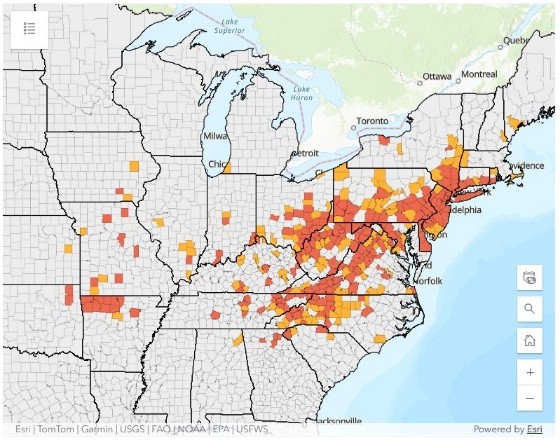
Figure 1. Reported distribution of Asian longhorned ticks including established counties (5+ detections or 2 or more life stages), reported counties (<5 detections of one life stage), and no data. Data is based on NVSL reports and self-reporting to the Vector Vector-Borne Disease Watch as of July 2026 (https://vectorvbdwatch.tennessee.edu/longhorned_tick_and_theileria/)
Distribution of Theileria-infected ticks
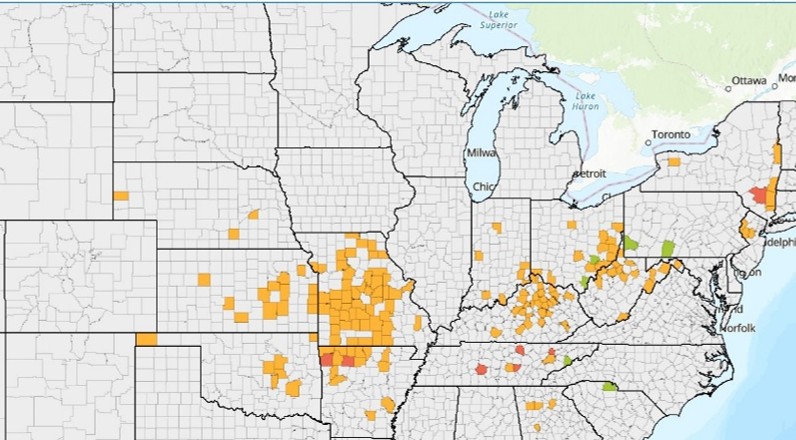
Figure 2. Reported distribution of Theileria-infected ticks (green), cattle (orange), and both (red). Data is based on NVSL reports and self-reporting to the Vector Vector-Borne Disease Watch as of July 2026 (https://vectorvbdwatch.tennessee.edu/longhorned_tick_and_theileria/)
New World Screwworm Updates
The meeting focused on updates regarding New World Screwworm in Texas, with Renee Holmes reporting 41 total cases (13 active/29 inactive) and two new counties added. Active cases are represented in orange and inactive cases are represented in blue. Active cases are currently in 6 Texas counties (Crockett, Pecos, Brewster, Sutton, Uvalde, and Starr).
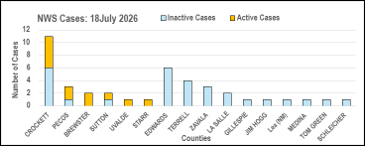
Figure 1. Counties with New World Screwworm Cases Reported. Data can be located in table to right of chart.
Map of Counties with Detections All Time
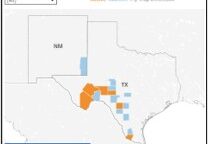
Figure 2. Map of Counties with Detections All time. Active cases (orange) and inactive cases (light blue) are shown on this map.
| Texas County | Inactive Cases | Active Cases |
|---|---|---|
| Crockett | 6 | 5 |
| Pecos | 1 | 2 |
| Brewster | 0 | 2 |
| Sutton | 1 | 1 |
| Uvalde | 0 | 1 |
| Starr | 0 | 1 |
| Edwards | 6 | 0 |
| Terrell | 4 | 0 |
| Zavala | 3 | 0 |
| La Salle | 2 | 0 |
| Gillespie | 1 | 0 |
| Jim Hogg | 1 | 0 |
| Lea (NM) | 1 | 0 |
| Medina | 1 | 0 |
| Tom Green | 1 | 0 |
| Schleicher | 1 | 0 |
New World Screwworm detections have only come from domesticated animals thus far, including cattle, sheep, goats, and dogs. The first detection occurred in epidemiological week 23 of 2026. All cases detected between epidemiological week 23 through 26 are now considered inactive.
New World Screwworm Animal Hosts – July 2026
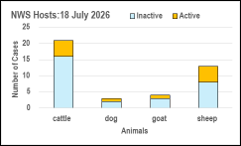
| Type of Animal | Inactive Cases | Active Cases |
|---|---|---|
| Cattle | 16 | 5 |
| Dog | 2 | 1 |
| Goat | 3 | 1 |
| Sheep | 8 | 5 |
New World Screwworm data were accessed from the USDA APHIS Confirmed Detections of New World Screwworm dashboard on July 18, 2026.
New World Screwworm Epidemiological Weeks Cases – July 2026
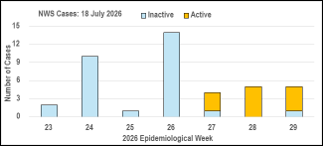
| Epidemiological Week | Inactive Cases | Active Cases |
|---|---|---|
| 23 | 2 | 0 |
| 24 | 10 | 0 |
| 25 | 1 | 0 |
| 26 | 14 | 0 |
| 27 | 1 | 3 |
| 28 | 0 | 5 |
| 29 | 1 | 4 |
New World Screwworm data were accessed from the USDA APHIS Confirmed Detections of New World Screwworm dashboard on July 18, 2026.